Big weather around the world
Some of the planet’s most powerful weather rarely or never reaches southern Alberta. Here’s a quick guide to each one, whether it could happen here, and where to learn more.
Derechos
A derecho is a long line of thunderstorms that races across hundreds of kilometres, flattening trees and power lines with straight-line winds rather than spinning ones.
In Canada: on May 21, 2022, a derecho tore across southern Ontario and Quebec, causing over $875 million in insured damage, the sixth-largest insured loss in Canadian history at the time. Derechos are rare on the Prairies, but they can happen.
Learn more: Northern Tornadoes Project, Western University, which also surveys derecho damage.
Waterspouts
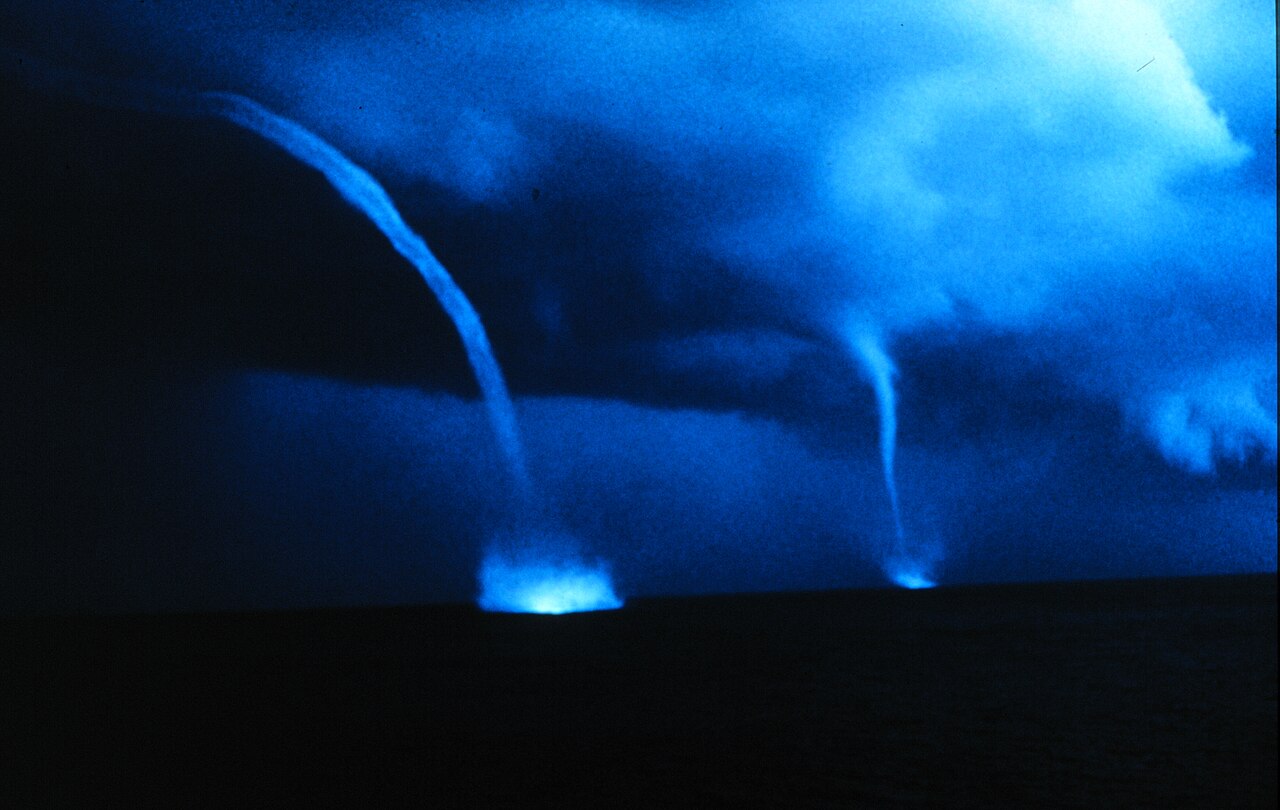
A waterspout is a spinning column of air over water. Most are “fair-weather” waterspouts that grow up from the water surface under building clouds, much like a dust devil on land. A few are true tornadoes that move out over water, and those are dangerous.
In Canada: they’re seen most often over the Great Lakes, especially in late summer and fall when the water is still warm and cold air passes over it. On a big lake or reservoir here, stay off the water when storms are building.
Hurricanes
Hurricanes are huge spinning storms that form over warm tropical oceans, with winds of at least 119 km/h, torrential rain and dangerous storm surge along the coast.
In Canada: by the time they reach Atlantic Canada they’re often weakening or changing into strong post-tropical storms, but they can still do enormous damage. Fiona, which hit Atlantic Canada and eastern Quebec on September 24, 2022, caused over $800 million in insured damage, the costliest extreme weather event ever recorded in Atlantic Canada. Hurricanes can’t reach Alberta: they lose their power over land and the Rockies stand in the way from the Pacific side.
Learn more: Canadian Hurricane Centre, Environment and Climate Change Canada
Ice storms
An ice storm is a long spell of freezing rain: rain falling through a layer of warm air aloft and then freezing the moment it hits cold ground, trees and wires.
In Canada: the Great Ice Storm of January 4 to 10, 1998 dropped up to 100 mm of freezing rain and ice pellets on the St. Lawrence Valley. Nearly 1.4 million customers in Quebec and over 230,000 in eastern Ontario lost power, as many as 35 people died, and more than 15,000 Canadian Forces members were deployed to help. Freezing rain does happen in southern Alberta, usually in short spells, so it’s worth knowing the signs.
Learn more: Ice Storm 1998, The Canadian Encyclopedia
Dust storms (haboobs)
A haboob is a towering wall of dust pushed ahead of a thunderstorm by the cold air rushing out of it. They’re famous in the Sahara, the Middle East and the deserts of Arizona.
Closer to home: the Prairies have their own dust-storm history. During the drought of the 1930s, the “Dirty Thirties,” strong winds stripped topsoil from dry fields across southern Alberta and Saskatchewan. Today, soil conservation practices like reduced tillage and shelterbelts help keep the soil where it belongs, but blowing dust can still cut visibility on windy days in dry years.
Monsoons
A monsoon is a seasonal shift in the winds that brings a long rainy season, most famously to India and South Asia every summer. The southwestern U.S. and Mexico get a smaller summer monsoon that brings afternoon thunderstorms to Arizona and New Mexico.
Here: we don’t have a monsoon, but our wettest months are late spring and early summer, when Pacific storms and thunderstorms bring most of the year’s rain.
Tsunamis
A tsunami isn’t weather at all. It’s a series of ocean waves caused by an undersea earthquake, landslide or volcano, which can race across an ocean and surge far inland.
In Canada: on March 28, 1964, a magnitude 9.2 earthquake in Alaska sent a tsunami down the BC coast. Funnelled up the narrow Alberni Inlet, it surged into Port Alberni just after midnight, lifting cars and shifting buildings off their foundations. Remarkably, no one was killed. Alberta is far from any ocean, but if you visit the BC coast, learn the tsunami signs: strong shaking, or the sea suddenly pulling back, means head for high ground right away.
Learn more: 50 years after the Port Alberni tsunami, Times Colonist
Sources
- 2022 derecho insured damage, Insurance Canada (IBC and CatIQ figures)
- Insured damages from Hurricane Fiona, Insurance Bureau of Canada
- Ice Storm 1998, The Canadian Encyclopedia
- Port Alberni tsunami, Times Colonist
More Weather Wonders
← All Weather Wonders · Chinooks · Hail · Tornadoes · Thunderstorms · Dust devils · Blizzards · Frost and fog · Sky wonders · Around the world