Tornadoes on the Prairies
Canada gets more tornadoes than almost any country on Earth, and Alberta sees about 15 in a typical year. Most are small and short-lived, but knowing the signs and what to do could save your life.
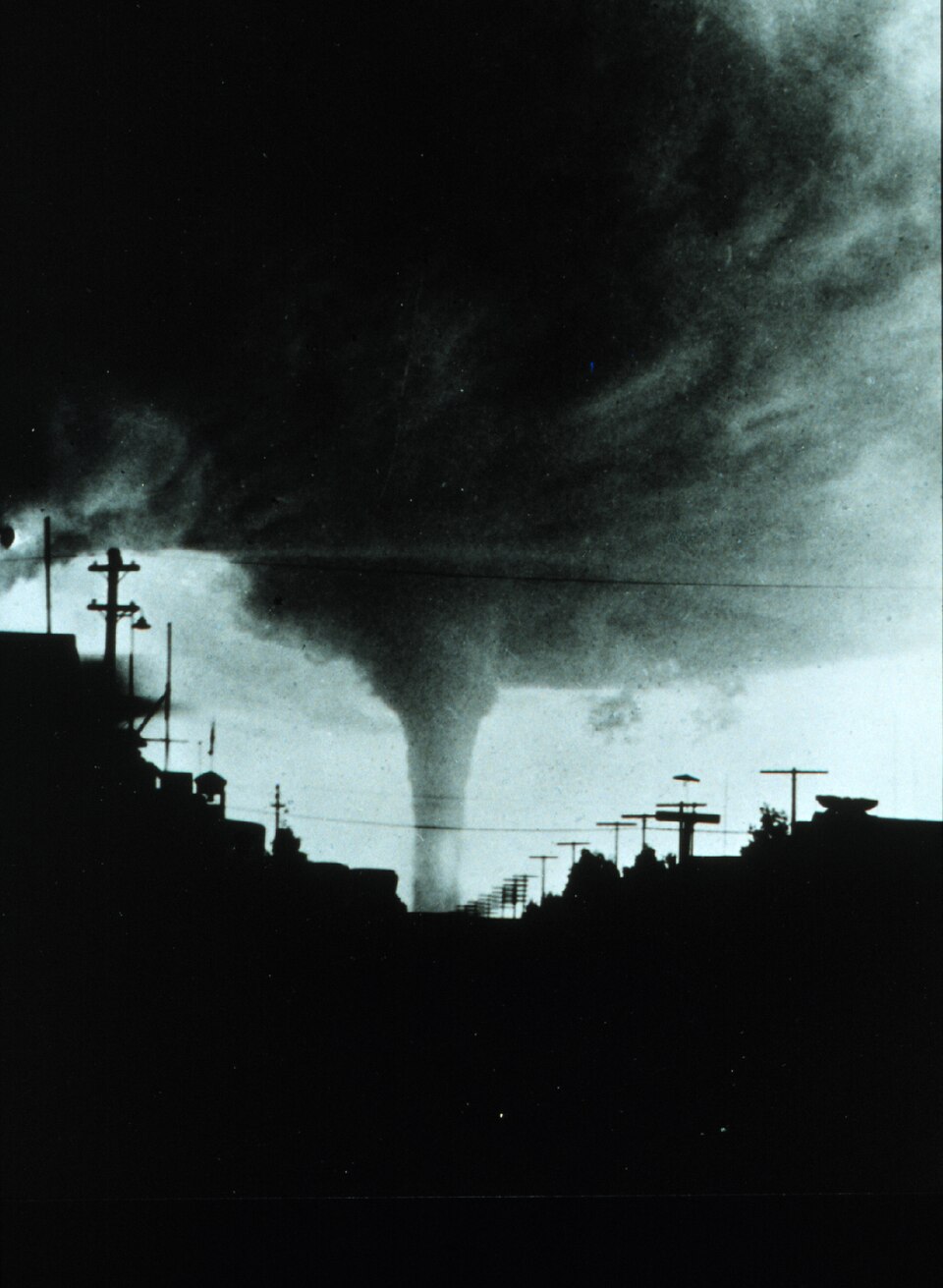
What is a tornado?
A tornado is a violently spinning column of air that reaches from a thunderstorm cloud down to the ground. If the spinning funnel doesn’t touch the ground, it’s called a funnel cloud. Once it touches down, it’s a tornado, even if you can’t see the funnel all the way down: sometimes the only sign at ground level is a swirling cloud of dust and debris.
How they form
- Supercell tornadoes: the strongest tornadoes come from supercells, long-lived thunderstorms with a rotating updraft. Winds that change direction and speed with height set the storm spinning, and under the right conditions part of that spin tightens into a tornado.
- Landspouts: common on the Prairies, these form under growing storm clouds without a strong rotating storm, often along a line where winds meet. They’re usually weaker and short-lived, but can still do damage.
The deeper science of severe storms is in Weather School: Southern Alberta Storms.
Tornadoes in Canada and Alberta
- Canada is often described as the world’s second-most tornado-prone country, after the United States.
- Alberta averaged about 15 tornadoes a year from 1980 to 2009. Some years are much busier: 2019 had 23.
- Tornado season runs mainly from April to September, though tornadoes can happen at other times.
- Western University’s Northern Tornadoes Project works with Environment and Climate Change Canada to find, survey and rate every tornado in the country, using ground and drone surveys and satellite pictures. They find many tornadoes in remote areas that would once have gone uncounted.
How tornadoes are rated
Since 2013 Canada has rated tornadoes on the Enhanced Fujita (EF) scale, from EF0 (weakest) to EF5 (strongest). Nobody measures a tornado’s wind directly. Instead, surveyors study the damage, such as how a roof, a barn or a stand of trees failed, and work out the wind speed it would take.
- EF0 and EF1: broken branches, damaged shingles and siding, toppled sheds. Most Alberta tornadoes fall here.
- EF2 and EF3: roofs torn off, mobile homes destroyed, large trees snapped.
- EF4 and EF5: well-built homes levelled. Very rare in Canada.
Watches, warnings and warning signs
- Tornado watch: conditions are right for tornadoes to develop. Keep an eye on the sky and the forecast, and know where you’d shelter.
- Tornado warning: a tornado is happening or is about to happen nearby. Take shelter now.
Alerts are issued by Environment Canada and sent to phones in the warned area. Signs that a tornado may be near:
- A loud, continuous roar, like a freight train or a waterfall
- Large hail
- A dark, sometimes greenish sky
- A rotating, lowering cloud base, or swirling dust and debris at ground level
What to do
- In a house: go to the basement or the lowest floor. Get into a small inner room, closet or hallway, away from windows and outside doors, with as many walls as possible between you and the outside. Cover your head and neck. Stay there until the warning ends.
- In a vehicle, trailer or RV: don’t stay in it. A tornado can lift and throw vehicles and mobile homes. Get to a sturdy building if you safely can.
- Caught outside: lie flat in a ditch or low spot, away from trees and vehicles, and cover your head.
- Afterwards: watch for downed power lines, broken glass and gas leaks.
Build your kit ahead of time with our home emergency kit and vehicle kit guides.
Key terms
- Funnel cloud
- A spinning funnel hanging from a cloud that hasn’t reached the ground.
- Supercell
- A long-lived thunderstorm with a rotating updraft, the source of most strong tornadoes.
- Landspout
- A usually weaker tornado that forms without a rotating storm, common on the Prairies.
- EF scale
- The Enhanced Fujita scale, which rates tornadoes from EF0 to EF5 based on the damage they do.
Learn more
- Northern Tornadoes Project, Western University (maps of recent Canadian tornadoes)
- Weather School: Southern Alberta Storms
- Lethbridge forecast and alerts, Environment and Climate Change Canada
Sources: CBC News (Alberta tornado averages and the Northern Tornadoes Project); Western University news (Alberta’s F4 and EF4 tornadoes, Didsbury 2023, EF scale since 2013); The Weather Network (season, warning signs and safety).
More Weather Wonders
← All Weather Wonders · Chinooks · Hail · Tornadoes · Thunderstorms · Dust devils · Blizzards · Frost and fog · Sky wonders · Around the world