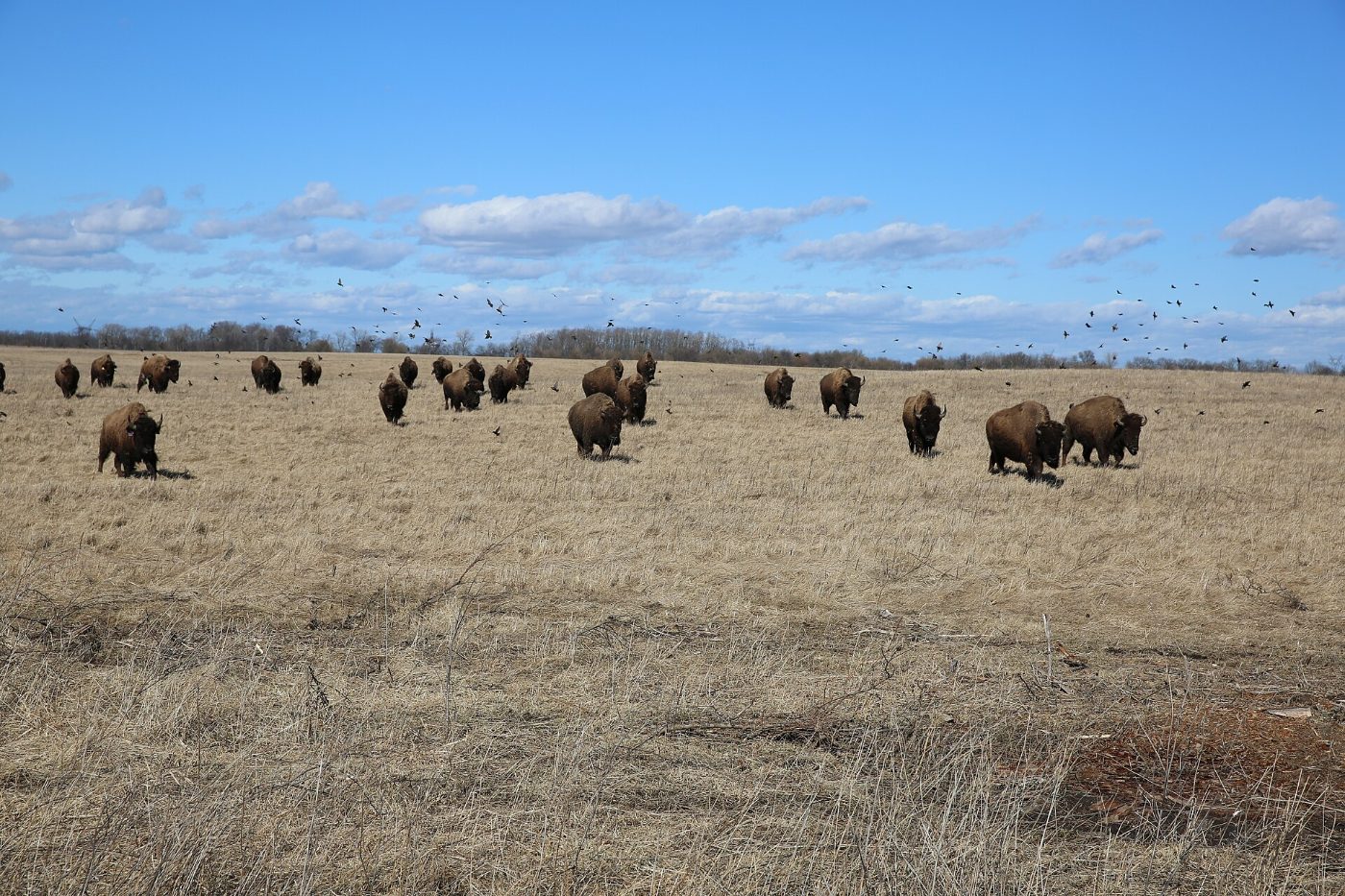
Just west of Lethbridge you can often spot a herd of bison grazing behind a tall fence. It’s a fitting sight. For thousands of years, these grasslands belonged to the bison.
A near miss
Estimates of how many plains bison once lived in North America range from about 10 million to 70 million. Within a few decades of the arrival of commercial hunting and the railways, they were nearly gone. By 1890 only a few hundred plains bison were left in Canada and the United States combined.
Canada helped bring them back. In 1907 the government bought one of the last large herds, in Montana, and many of today’s purebred plains bison descend from a small group of 45 animals kept at Elk Island, east of Edmonton. In 2017 Parks Canada returned 16 plains bison to Banff National Park, the first bison there in more than a century.
Bison and the Blackfoot
Bison were at the centre of Blackfoot life: food, clothing, shelter, tools and ceremony. About an hour’s drive west of Lethbridge, Head-Smashed-In Buffalo Jump (Estipah-skikikini-kots) was used for more than 5,000 years. Hunters guided herds along drive lanes marked by hundreds of stone cairns and over cliffs 10 to 18 metres high. Bone deposits below the cliff are up to 11 metres deep. It became a UNESCO World Heritage Site in 1981, and its interpretive centre near Fort Macleod is well worth a visit.
Bison ranching today
- Canada had about 150,000 bison on 989 farms and ranches in 2021, up 25% in five years.
- Alberta had about 65,000 of them on 472 farms, more than any other province.
- Bison are mostly raised on grass, behind fences that are taller and stronger than cattle fences.
- Bison meat is lean, and the United States is its biggest export market.
Watch from the road
Bison may look slow and shaggy, but they’re big, fast and unpredictable, and a big bull can weigh close to a tonne. Enjoy them from your vehicle or the roadside, never go past a fence, and keep dogs on a leash.
Learn more
See the bison tile in our Farm Country guide and our History and Heritage page. Sources: Canadian Bison Association (2021 Census data); The Canadian Encyclopedia; Parks Canada.
Top photo: USDA Forest Service, public domain.