Rocks and minerals: become a rock detective
Every rock has a story millions of years long. Learn the three kinds of rocks, how to test minerals like a geologist, and how to start your own collection.
Rock or mineral? What’s the difference?
A mineral is a natural solid that’s the same all the way through, with its own recipe of chemical ingredients, like quartz, salt, or gold.
A rock is a mix of minerals stuck together. Think of minerals as the ingredients, and a rock as the cookie!
🌋 Igneous rocks
Made when hot, melted rock (magma or lava) cools and hardens. Granite and basalt are igneous. Igneous comes from the Latin word for fire.
🏖 Sedimentary rocks
Made from layers of sand, mud and shells pressed together over millions of years. Sandstone, shale and coal are sedimentary. This is the kind that makes up our coulee walls, and where fossils are found.
🔥 Metamorphic rocks
Made when other rocks are squeezed and heated deep underground until they change. Sandstone becomes quartzite; shale becomes slate.
The rock cycle
Rocks are always slowly changing from one kind to another. Mountains wear down into sand. The sand becomes sandstone. Deep underground, heat and pressure change it into quartzite. Pushed up again in a mountain range, it wears down again. Round and round, over millions of years.
Test minerals like a geologist
Hardness: in 1812, Friedrich Mohs made a scale from 1 (softest) to 10 (hardest). A harder mineral scratches a softer one.
| Hardness | Mineral | Test it with |
|---|---|---|
| 1 | Talc | Very soft, feels soapy |
| 2 to 2.5 | Gypsum | Your fingernail scratches it |
| 3 | Calcite | A copper coin scratches it |
| 5.5 | (Glass) | A steel nail scratches it |
| 7 | Quartz | Scratches glass |
| 10 | Diamond | Hardest natural mineral |
Streak: rub a mineral on the back of a white bathroom tile. The colour of the powder line is its streak. Some minerals have a streak that’s a different colour from the mineral itself!
Lustre: does it shine like metal, sparkle like glass, or look dull like chalk?
Alberta’s own gemstone: ammolite
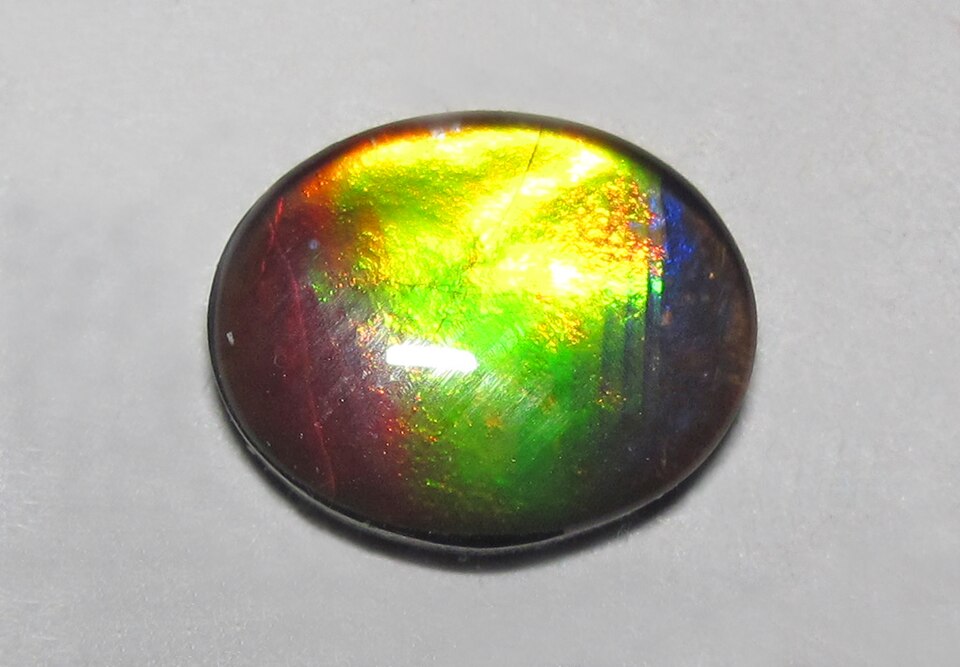
Ammolite is one of the rarest gemstones on Earth, and it’s found almost only in southern Alberta. It’s made from the fossil shells of ammonites, sea creatures with coiled shells that lived here about 71 million years ago when a warm sea covered the prairies. Its colours shimmer like a rainbow. In 2022, ammolite became Alberta’s official gemstone.
✏ Try it yourself: start a rock collection
- Use an egg carton as your first display case.
- For each rock, write a label: where you found it, the date, and your best guess of what it is.
- Test each one: does it scratch glass? What’s its streak? Does it fizz in a drop of vinegar? (Calcite and limestone do!)
- Look closely with a magnifying glass. Can you see different mineral grains?
❓ Quick quiz
Guess first, then tap to see the answer.
A rock is made of what?
Minerals stuck together.
Which kind of rock forms from layers of sand and mud, and holds fossils?
Sedimentary rock.
Your fingernail scratches a mineral. Is it hard or soft?
Soft. Your fingernail is only about 2.5 on the Mohs scale.
What is Alberta’s official gemstone, and what is it made from?
Ammolite, made from the fossil shells of ammonites.
🏫 For teachers and parents
- Ages: 6 to 13; links to Alberta grade 3 “Rocks and Minerals” and grade 7 “Planet Earth” science topics.
- Rock detective lab: give each table 6 rocks, a nail, a copper coin, a tile and a magnifier; students record hardness, streak and lustre.
- Chocolate rock cycle: grated chocolate (sediment) pressed into a “sedimentary” bar, warmed into “metamorphic”, melted and cooled into “igneous”. Tasty, and it sticks in the memory.
- Field trip ideas: the Oldman River gravel bars (with supervision), and the Galt Museum for local coal history.
- More ideas in the Teachers’ Corner.
More Earth Explorers
Sources: Government of Alberta, Designating Alberta’s official gemstone; Royal Tyrrell Museum, fossil collecting rules.