Camp Gear
The gear that actually earns its place: sleeping warm, staying dry, cooking safely, clean water, keeping food cold, light and power, and clothing and footwear for a day that can start near freezing and end in sunscreen. Generic descriptions only, no brands, and a strong suggestion to ask questions before you spend.
On this page
Before you spend
Camping gear is a big business, and it’s easy to come home from a store with a car full of things you’ll use once. Gary has bought his share over the years. His advice to every new camper and RVer:
“Ask questions before you spend all the money. Make sure you know what you’re getting and if you really truly can use it or need it, or if it’s of any benefit or just a waste of money. I’ve found so many things over the years that I thought were a great idea were a lousy investment.”
“Make sure you have the very basics covered. Make yourself a very good list and consider everything you are going to experience where you’re going, and be as prepared as you can.”
Questions to ask
- What problem does this solve, and do I actually have that problem?
- Will it work here? In our wind, our cold nights, our hard ground and our dust?
- Do I already own something that does the job? Kitchen pots, a home first aid kit and warm wool sweaters often do fine.
- Can I borrow or rent it first? Especially big items: tents, stoves, trailers.
- How heavy and bulky is it, and where will it go in the vehicle?
- Can it be repaired, and are parts and fuel easy to find?
- Who has used one? Ask friends, ask at the campground, ask people who camp the way you want to.
What it means for you: spend first on the things that keep you warm, dry and safe: sleeping bag and pad, rain jacket, warm layers, decent footwear, a reliable stove, water treatment and a first aid kit. Comfort extras can wait until you know what you miss.
Sleeping warm: bags and ratings
A cold night is the most common reason people give up on camping. In southern Alberta, summer nights can fall to single digits, and spring, fall and mountain nights can drop below freezing. Plan for the low, not the high.
Temperature ratings
Many sleeping bags are tested to an international standard, ISO 23537, and labelled with temperatures that mean something specific:
| Label | What it means | How to use it |
|---|---|---|
| Comfort | The temperature at which a standard woman can expect to sleep comfortably in a relaxed position. | The best guide for most people, and especially for anyone who sleeps cold. |
| Limit (lower limit) | The temperature at which a standard man can sleep for eight hours curled up without waking. | Warm sleepers may use this as the coldest the bag suits. You’ll be curled up, not relaxed. |
| Extreme (risk) | A survival-only rating. Between the limit and this number, expect strong cold and a real risk of hypothermia. | Never plan a trip around this number. |
Bags that aren’t tested to the standard may use a single number chosen by the maker, which can be optimistic. Ratings also assume you’re on a properly insulated pad and wearing a base layer.
- Choose a comfort rating at or below the coldest night you expect, with a few degrees to spare.
- Down fill is warm for its weight and packs small, but loses warmth when wet unless treated. Synthetic fill is heavier and bulkier but keeps more warmth when damp, and is usually cheaper.
- Shape matters. Mummy bags are warmer because there’s less air to heat. Rectangular bags are roomier but colder.
- A liner adds a few degrees and keeps the bag clean.
- Children’s bags should fit the child. A big adult bag leaves cold space around a small body. The ISO rating system doesn’t cover children’s bags, so a child’s bag rating is the maker’s own; choose one with a generous margin, and check on young children during a cold night.
- Store bags loose, not compressed in their stuff sack, so the fill keeps its loft.
Pads and R-value
The ground pulls heat from your body all night. A sleeping bag’s fill gets squashed flat underneath you, so it’s the pad that does the insulating there. That’s why a great bag on a thin pad can still be a cold night.
A pad’s insulation is given as an R-value. Many pads are now tested to a common method, ASTM F3340, so R-values from different makers can be compared. The higher the R-value, the better the pad resists the cold. Pads that haven’t been tested to the standard may list an estimated value.
| Type | Pros | Cons |
|---|---|---|
| Closed-cell foam | Cheap, can’t puncture, works as a sit pad, adds warmth under another pad. | Bulky, firm, modest R-value on its own. |
| Self-inflating | Comfortable, good insulation, durable. | Heavier and bulkier than air pads. |
| Insulated air pad | Thick and comfortable, packs small, can have high R-values. | Can puncture; carry a repair kit. Some are noisy. |
| Uninsulated air mattress | Cheap and comfortable in warm weather. | Cold: the air inside circulates and carries your heat to the ground. Put foam or a blanket on top in cool weather. |
| Cot | Off the ground, easy to get in and out of. | Cold air flows underneath; it still needs a pad on top. |
What it means for you: for spring, fall or mountain trips, use a higher R-value pad, or stack two: a closed-cell foam pad under an inflatable one is a common and effective combination.
Heated and USB options
Heated blankets, mattress pads, socks and vests that run from a USB battery pack, and electric blankets for powered sites, can make a cold night much more comfortable. They can also create fire and burn risks if they’re cheap, damaged or misused.
- Buy certified products. Health Canada advises using chargers with a Canadian certification mark, and the same thinking applies to anything that heats up next to your body.
- Charge away from bedding. Health Canada’s battery advice is to charge away from soft surfaces and bedding to prevent overheating. Don’t charge a battery pack inside a sleeping bag or under a pillow.
- Stop using any battery that swells or overheats, and any heated product with damaged wires or scorch marks.
- Keep batteries at moderate temperatures. Health Canada says to store them at room temperature. A battery pack left in a hot vehicle or in the sun is at risk; in the cold it simply runs down faster.
- Follow the instructions on whether the product is meant to stay on while you sleep, and use the timer or low setting where there is one.
- Take extra care with children, older adults and anyone who can’t easily feel heat or move away from it. Don’t use heated pads or blankets on babies or toddlers.
- Have a non-electric backup. A battery can die at 3 a.m. A warmer bag, a hat and dry socks don’t.
Never use a fuel-burning heater to warm a tent or a closed trailer while you sleep. It’s a carbon monoxide and fire risk. See carbon monoxide.
Shelter, ground sheets and tarps
The tent itself is covered on Tent camping. Around it, a few simple pieces make camp much more liveable in our weather.
- Ground sheet. Under the tent, cut or folded slightly smaller than the floor so rain can’t collect on it and run underneath.
- Tarp over the kitchen and sitting area. Gives shade on a hot afternoon and a dry place to cook in rain. Pitch it low and angled on the windward side, with one corner lower so water runs off. A flat, high tarp in wind becomes a kite.
- Heavy-duty tarp and plenty of cord. Thin tarps tear at the grommets in wind. Reinforced corners and extra tie-out points help.
- Strong stakes. Longer, sturdier stakes hold in prairie clay and gravel where thin pegs pull out or bend.
- Adjustable lines. A friction hitch, such as a taut-line or Prusik hitch, lets you tighten a line without retying. See knots.
- Screen shelter. A bug shelter over the picnic table helps in mosquito season along rivers and lakes, but take it down before strong wind does it for you.
- Windbreak. A tarp strung between trees or along the vehicle on the windward side can turn a miserable site into a sheltered one.
Pitching tarps and shelters for prairie wind is covered in more depth on Bushcraft, Fieldcraft and Navigation.
Stoves and fuel
| Stove and fuel | Good for | Watch for |
|---|---|---|
| Two-burner propane stove (small cylinders or a refillable tank) | Car camping and family cooking. Propane works in cold weather. Refillable tanks are cheaper over time. | Bulky. Check hoses and fittings for leaks. Don’t refill or dispose of small cylinders in the garbage; follow local rules. |
| Single-burner canister stove (butane or butane-propane mix) | Light trips, boiling water fast, backup stove. | Butane loses pressure near freezing; mixed-fuel canisters do better but still slow down in the cold. Keep canisters warm in a jacket or sleeping bag before cooking on a cold morning. |
| Liquid-fuel stove | Cold weather and long trips. | Needs priming and practice. Spills are a fire risk. |
| Wood or charcoal | A campfire meal is part of the fun. | Not allowed during fire bans, and charcoal or wood appliances without an on/off valve are banned too. Always have a backup stove. |
During a fire ban in Alberta, the province allows propane, natural gas and electric appliances that have an on/off switch or valve. Check fire bans before every trip.
- Cook outside, on a stable surface, away from the tent and anything that burns.
- Use a windscreen where the stove’s instructions allow it. Wind steals heat and fuel. Never enclose a canister so tightly it overheats.
- Store fuel well away from the tent and from sources of ignition.
- Light it with your face and hands back from the burner, and turn it off at the valve when done.
- Carry two ways to light it, such as a lighter and waterproof matches.
Never use a stove, barbecue or lantern inside a tent, trailer, vehicle or garage. Health Canada warns never to use a barbecue, camping stove or fuel-burning equipment in your home, garage or shed. The same carbon monoxide risk applies inside a tent or camper.
Water: filtering and treating
Lakes, rivers and streams here can look clean and still carry bacteria, viruses and parasites such as Giardia, often called “beaver fever”. Treat any water that doesn’t come from a tap marked as safe drinking water. Some campgrounds have no drinking water at all, so check before you go.
Alberta Health Services’ methods
| Method | How | Notes |
|---|---|---|
| Boiling | Bring water to a rolling boil for 1 minute. | AHS calls boiling always the best way to disinfect. Let it cool in a covered pot. |
| Household bleach (unscented, 5.25%) | Clear water: 2 drops per litre, then let it stand 30 minutes. Cloudy water: 4 drops per litre; if there’s no chlorine smell after 30 minutes, add 4 more drops and wait another 30. | Use plain, unscented bleach only. Doesn’t reliably kill some parasites, so filter first if you can. |
| Iodine (2% liquid) | 5 drops per litre; wait 30 minutes in warm water, 40 minutes in cold. Double the drops for cloudy water. | Not for people who are pregnant or have thyroid problems, and limit use to about 3 weeks a summer. |
| Filter | A filter rated at 1 micron absolute or smaller, certified for cyst reduction (NSF standard 53 or 58). | Removes parasites that chlorine and iodine don’t kill. Filter first, then disinfect with chlorine or iodine. |
| Ultraviolet (UV) treatment | Follow the device’s instructions exactly. | Needs clear water; let sediment settle first. AHS recommends disinfecting with chlorine or iodine afterwards too. |
Health Canada adds that any treatment device you buy should be certified to the applicable NSF/ANSI performance standard; look for the certification mark on the package. For parasitic cysts, that’s NSF/ANSI 53.
- Pre-filter muddy water through a cloth or let it settle before treating. Prairie rivers and reservoirs are often silty.
- Keep treated and untreated water separate, with clearly marked containers.
- Bring enough drinking water from home for the first day or two, especially for children.
- In hot weather, plan on more water than you think. See heat.
Food and cooler safety
A warm cooler on a hot August afternoon is how camping trips end in food poisoning. Health Canada’s summer food safety advice:
- Keep the cooler at or below 4°C. Use plenty of ice or ice packs, and a fridge thermometer in the cooler if you can.
- Don’t leave food out more than an hour on hot days. Bacteria can grow quickly between 4°C and 60°C.
- Use separate coolers for drinks and food. The drinks cooler gets opened constantly; the food cooler stays colder.
- Raw meat, poultry and fish go at the bottom, well wrapped, so juices can’t drip on other food.
- Cook meat to a safe internal temperature and check with a digital food thermometer. Colour isn’t a reliable guide.
- Wash your hands with soap and warm water for at least 20 seconds before and after handling food. A jug with a spout and a bar of soap makes a camp hand-washing station.
Making the cold last
- Pre-chill the cooler and the food at home.
- Freeze water bottles or meals to use as ice that becomes drinking water or dinner.
- Keep the cooler in the shade, off hot ground, and covered with a blanket or sleeping bag.
- Open it as little as possible, and drain meltwater that isn’t keeping things cold.
- Pack in the order you’ll use it: tonight’s dinner on top, the last day’s meals at the bottom.
Coolers are not bear-proof. Parks Canada says even locked coolers aren’t. In bear country, and anywhere wildlife is about, store food, garbage, coolers and anything scented in a hard-sided vehicle or a bear-proof locker when you aren’t using them. Never leave food unattended.
Lighting
- A headlamp for everyone. It leaves both hands free for cooking, setting up and the walk to the washroom. Give children their own.
- Red-light mode keeps your night vision and doesn’t blind your neighbours. It’s also the way to look at the stars; see dark skies.
- A battery or rechargeable lantern for the table and inside the tent. Battery LED lanterns are the safe choice inside.
- Fuel lanterns stay outside. Fuel-burning lanterns and heaters used inside tents, campers and vehicles have caused carbon monoxide deaths.
- Spare batteries or a way to recharge, kept warm on cold nights.
- Be a good neighbour with light: point lanterns down, turn off bright lights at quiet hours.
Power banks
A phone is now map, flashlight, weather radio and emergency line all in one. A dead phone at a campground with no power can be a real problem. Gary always carries an extra battery pack and cable:
“Surprising how many people have been stuck, no battery, no backup, no ability to call. I’ve even loaned out my battery pack so people could charge their own phone.”
- Carry at least one charged battery pack and the right cable for every device, plus a vehicle charger.
- Charge everything before you leave. Top up on the drive.
- Save phone battery where signal is weak: phones use more power searching for a signal. Airplane mode, low brightness and offline maps help.
- Download maps and the forecast before you lose signal.
- Keep batteries warm on cold nights (in a pocket or a bag, not in your sleeping bag while charging) and out of a hot vehicle in summer.
- Solar panels are useful on longer trips, but our clouds, short shoulder-season days and shade mean a battery pack charged at home is the reliable part.
- Check for certification marks and stop using any battery pack that swells, gets very hot or is damaged. Health Canada publishes recalls on its recalls site.
Clothing: anything but cotton
Our weather can swing through a whole year’s worth of conditions in a day. Gary says it best:
“Sometimes here you can be wearing everything you own in the morning and be in suntan lotion by the afternoon. You have to be prepared. That’s why I built my own weather station. You can’t live around here and not be cognizant of the weather. We get wild swings in temperature with chinooks.”
“ABC: Anything But Cotton. Cotton and denim are extremely cold materials. Avoid them at all costs.”
Cotton soaks up water, from rain or sweat, holds it against your skin and dries slowly. Wet clothing is a common cause of hypothermia, and the Canada Safety Council notes it can happen at temperatures under 10°C, well within a normal summer night here.
Layering
| Layer | Job | Good materials |
|---|---|---|
| Base layer | Moves sweat away from your skin. | Wool or synthetic (such as polyester or polypropylene) long underwear and tops. |
| Middle layer | Traps warmth, and stays warm when damp. | Wool sweater, fleece, a light insulated jacket. |
| Outer layer | Blocks wind and rain. | A waterproof, breathable rain jacket and rain pants, or a windproof shell. |
- Add and remove layers before you get cold or sweaty, not after.
- Pack a warm hat and gloves even in July. Mountain nights can be near freezing.
- Keep one set of dry clothes just for sleeping, sealed in a bag.
- Sun protection is clothing too: a wide-brimmed hat, sunglasses and a light long-sleeved shirt. See heat and sun.
- Rain gear isn’t optional. A thunderstorm can soak you in minutes.
Why does a wet cotton T-shirt make you so cold? Cotton is like a sponge: it soaks up water and holds it right against your skin. As that water slowly dries, it takes heat away from your body. Wool and fleece hold much less water, and they still trap warm air even when they’re damp.
Wonder: why do you feel cold getting out of a swimming pool on a windy day, even when the sun is shining?
Try this: wet a cotton sock and a wool or fleece sock, squeeze them both out, and hang them in the same spot. Which one dries first? Which one feels colder after ten minutes?
Footwear
Campgrounds are full of things to trip on: tent lines, roots, wet grass, slippery trailer steps, gravel, mud and cactus. Gary learned this the hard way:
“I’ve worn runners and twice fell in one day and hurt myself.” One fall drove his arm into his ribs, and he fell again going into the house.
“Wear shoes that aren’t junk: decent footwear, warm and waterproof, not so slippery.”
He has also seen a stranded driver, clearly not from here, in the cold snow wearing flip-flops.
- Sturdy, waterproof shoes or boots with a grippy sole for around camp and on trails.
- A second dry pair, because the first pair will get wet.
- Camp sandals or slip-ons are handy for the shower and the tent door, but not for hiking, fires, or rocky lakeshores.
- Closed toes around the campfire and on prairie ground with cactus.
- Wool or synthetic socks, not cotton, and spare pairs.
- Water shoes for rocky lakes and rivers.
- In the vehicle, keep proper footwear year-round. If you’re stranded, you’ll be walking in whatever is on your feet.
The small things
Some of the most useful things in camp are small. Gary carries a jacket with pockets set up as a tool pouch, and a truck with emergency kits, extra clothing, cookware and stoves. If he could keep only one tool, it would be a good multi-tool.
Multi-tool or knife
Pliers, blade, screwdrivers and a can opener in one. Keep it sharp and know the local rules on carrying blades.
Cord
A good length of strong cord for guy lines, tarps, clotheslines and repairs. Learn a few knots.
First aid kit
Bandages, blister care, tweezers for slivers and ticks, pain relievers, any personal medicines. Our mini first aid kit page is a good start for kids.
Whistle
Louder than a voice and lasts longer. Three blasts is a call for help. One for each child.
Repair kit
Tape, tent and pad patches, a pole repair sleeve, safety pins, zip ties, needle and strong thread.
Map and compass
Phones die and lose signal. A paper map of the area and a compass, and the know-how to use them.
Sun and bugs
Sunscreen SPF 30 or higher, lip balm, sunglasses, insect repellent, and a tick check routine.
Bags
Garbage bags, zip-top bags for wet things and food, and a bag for dirty laundry.
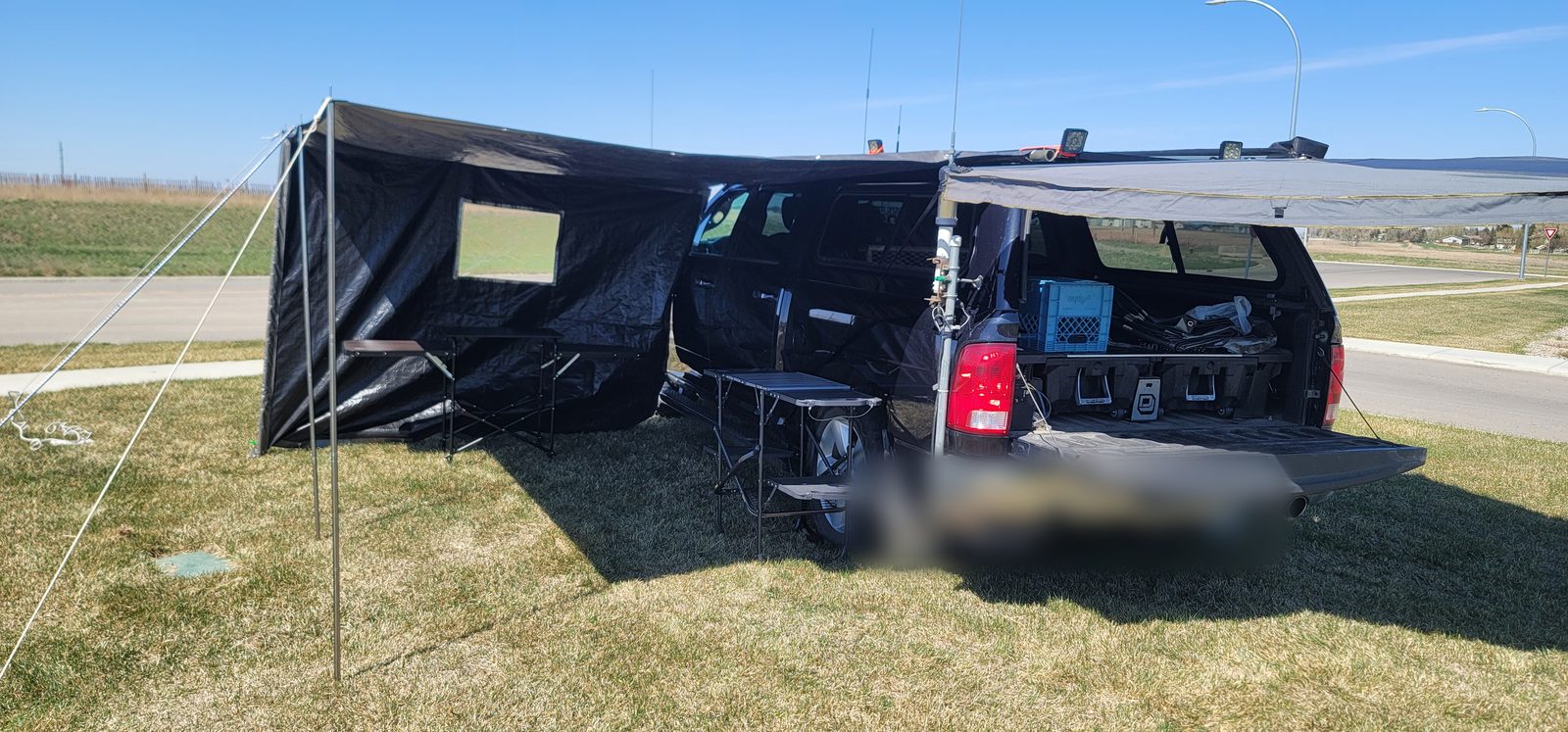
Gary’s truck camp setup
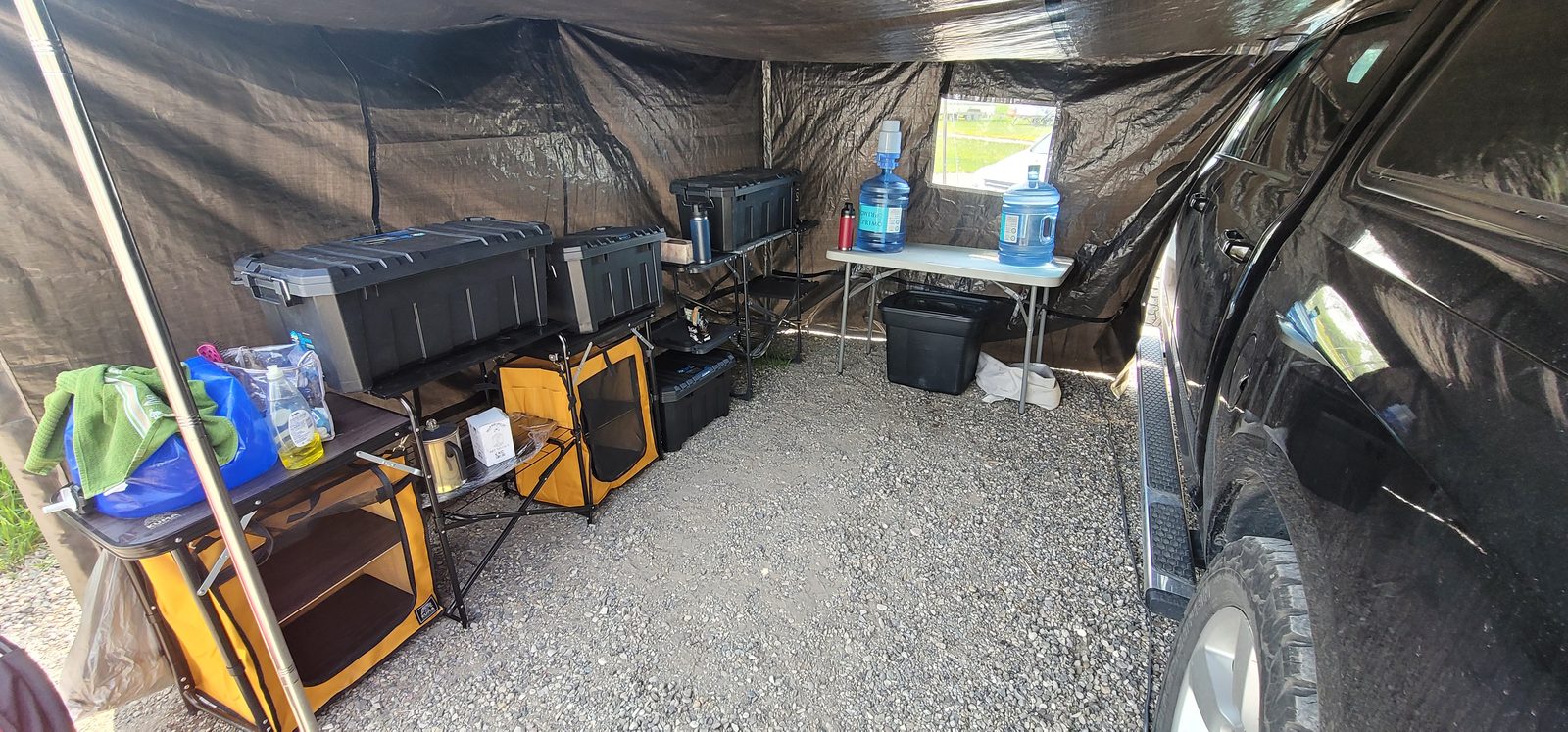
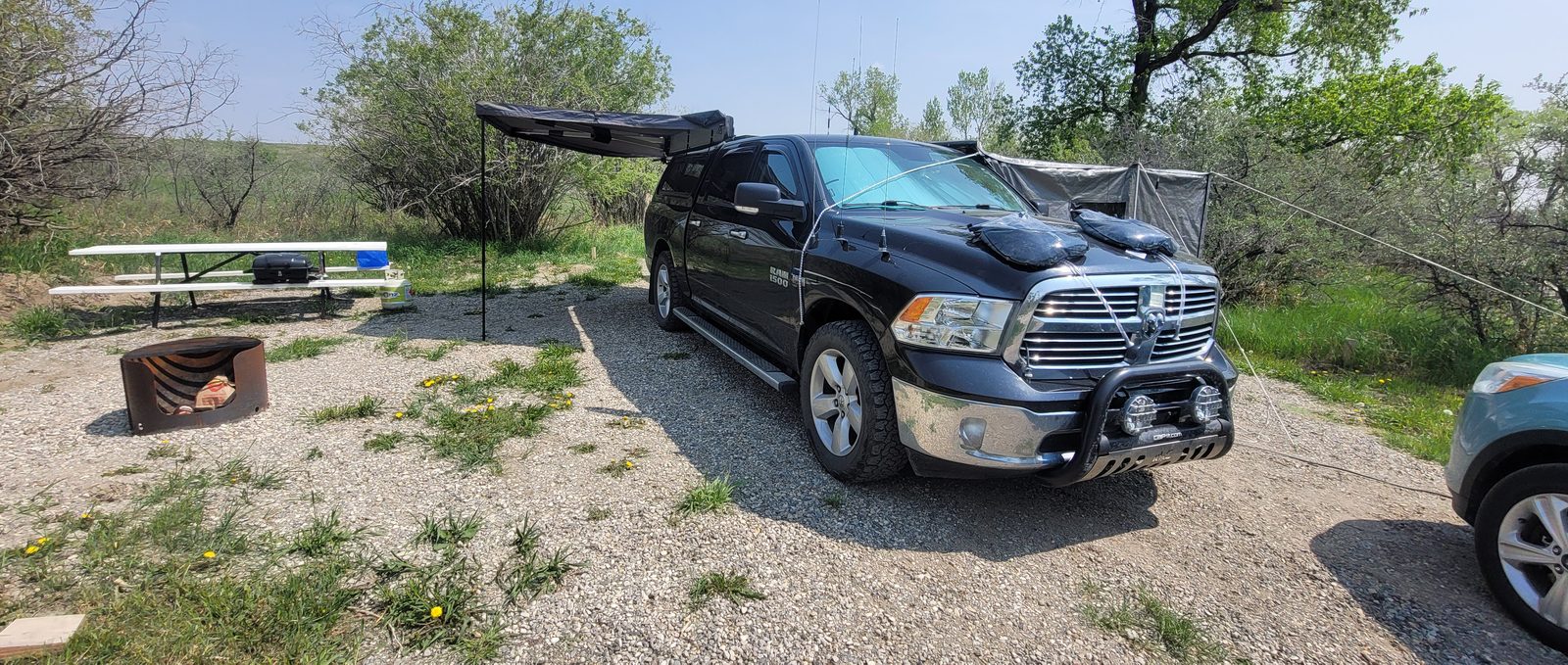
Gear for the places we camp
Mountains or coulees: each asks something different of your gear.
Waterton and the mountains: pack for winter
- Cold nights in summer. Parks Canada warns that nights in Waterton can fall below freezing even when the days are mild, and that snow and cold can come in any month.
- Wind. Very strong winds are common in Waterton, and Parks Canada says they “will quickly cause hypothermia.” A windproof outer layer, a warm hat and gloves belong in every pack, even in July.
- Bear spray. Carry it on your hip or chest, where you can reach it fast, and know how to use it. It isn’t applied to your body like bug spray.
- Water. Belly River Campground has no drinking water, so bring your own or a way to treat it.
- Signal. Cell reception outside the Waterton townsite is unreliable. Download maps before you go and carry a paper one.
Writing-on-Stone and the prairie: pack for heat
Alberta Parks advises drinking at least four litres of water a day in hot weather at Writing-on-Stone, with breaks in the shade and no hard exercise in the hottest part of the day. Bring large refillable jugs as well as everyone’s own bottle.
Cold nights at home, too
At the Lethbridge airport the average last spring frost is May 20 and the average first fall frost is September 17 (Environment and Climate Change Canada normals, 1981–2010). A trip on the May long weekend or in late September can easily bring a night below freezing, even on the prairie, so choose sleeping bags and pads for that.
When you get home: fuel and spray disposal
- Never put propane cylinders, bear spray or batteries in your blue, green or black cart. The City of Lethbridge treats them all as hazardous. A can of bear spray burst at the City’s recycling facility and forced an evacuation.
- Take them to the Waste and Recycling Centre. It accepts propane tanks and bottles and household hazardous waste, free for Lethbridge residents. Many refillable tanks can also go back to the retailer.
- Not sure? Ask the City through 311.
Sources
- International Organization for Standardization, ISO 23537-1:2022, Requirements for sleeping bags (thermal requirements and limit temperature): iso.org
- Comfort, limit and extreme are the label terms used with ISO 23537. Each bag’s own label and instructions give its tested figures.
- ASTM International, Standardization News, “New standard will help keep sleeping campers warm” (ASTM F3340 and R-value): sn.astm.org
- Health Canada, Factsheet: Don’t go up in smoke (battery and charger safety): canada.ca
- Government of Alberta, Fire bans (appliances allowed during a ban): alberta.ca
- Health Canada, Infographic: Carbon monoxide: canada.ca
- Halifax Regional Municipality, Tent and trailer camping fire safety (fuel storage away from tents): halifax.ca
- U.S. Consumer Product Safety Commission, Portable heaters and camping equipment (fuel-burning heaters and lanterns in tents and campers): cpsc.gov
- Alberta Health Services, Using disinfectants to make drinking water safe when you can’t boil it (MyHealth Alberta): myhealth.alberta.ca
- Health Canada, Questions and answers on drinking water treatment devices (NSF/ANSI certification): canada.ca
- Health Canada, Summer food safety tips (coolers at or below 4°C, one-hour rule, separate coolers): canada.ca
- Parks Canada, Wildlife safety, Waterton Lakes National Park (coolers not bear-proof, food storage): parks.canada.ca
- Canada Safety Council, The cold facts on hypothermia (wet clothing, under 10°C, layering): canadasafetycouncil.org
- Canadian Cancer Society, Be sun safe (SPF 30 or higher): cancer.ca
- Canadian Geographic Education, Hug-a-Tree and Survive (three whistle blasts): cangeoeducation.ca
- Parks Canada, Safety on land, Waterton Lakes National Park (strong winds and hypothermia; snow in any month; cell reception): pc.gc.ca
- Parks Canada, Camping, Waterton Lakes National Park (nights below freezing): parks.canada.ca
- Parks Canada, Wildlife safety, Waterton Lakes National Park (carrying bear spray): parks.canada.ca
- Parks Canada, Belly River Campground (no drinking water): parks.canada.ca
- Alberta Parks, Writing-on-Stone safety tips (four litres of water a day in hot weather): albertaparks.ca
- Environment and Climate Change Canada, Canadian Climate Normals 1981–2010, Lethbridge A (average frost dates): climate.weather.gc.ca
- City of Lethbridge, No ‘tanks’: keep propane out of your carts (2023): lethbridge.ca
- City of Lethbridge, Waste and Recycling Centre (propane tanks and bottles, household hazardous waste): lethbridge.ca
- CTV News Calgary, Can of bear spray bursts at Lethbridge recycling facility: ctvnews.ca