Tent Camping
How to choose a tent that will stand up to southern Alberta wind, pick a safe spot, pitch it so it stays put, stay dry and warm, and know when to leave it for the car. Written for first-timers and for anyone whose tent has ever tried to fly away.
On this page
Why tent camping
A tent is the cheapest and simplest way into camping, and the closest you’ll get to the outdoors without sleeping under the stars. You can pitch one at a provincial park, a town campground, a walk-in site, a backcountry campground or on public land. Tents pack small, need no towing, and don’t need a hook-up.
The trade-off is that you feel everything: the wind, the cold, the rain, the hard ground and the neighbour’s dog. In southern Alberta that mostly means wind. A good tent, well pitched, in a sensible spot, turns most of that from misery into part of the fun.
What it means for you: before your first trip, pitch the tent in the backyard or a park, in daylight, with the instructions. Then do it again in a breeze. You’ll learn where every pole goes, and you’ll find any missing stakes before you’re 100 km from home.
Choosing a tent for here
Tents are sold by the number of people they sleep and by season. For our conditions, a few features matter more than the rest.
| Feature | What to look for here |
|---|---|
| Season rating | A “three-season” tent is made for spring, summer and fall, and suits most camping here. “Four-season” tents are built for snow and strong wind, and are heavier and warmer. A sturdy three-season tent is the usual choice. |
| Shape and height | Lower, rounded dome shapes shed wind better than tall, flat-walled cabin tents. Cabin tents give headroom but act like a sail in a gust. |
| Poles | More pole crossings make a stiffer tent. Look for poles that cross several times, with clips or sleeves holding the tent body to them. Carry a pole repair sleeve. |
| Rainfly | A full-coverage fly that reaches nearly to the ground keeps out wind-driven rain and dust. Partial “cap” flies leave walls exposed. |
| Guy-out points | Loops partway up the fly for guy lines. A tent with plenty of them, and guy lines included, is a tent meant for wind. |
| Vents | Vents high in the fly let moist air out and cut condensation. |
| Floor | A “bathtub” floor that rises a few centimetres up the walls keeps out running water. |
| Vestibule | Covered space outside the door for boots and packs, so they stay dry and out of the sleeping area. |
| Size | A “four-person” tent fits four sleeping pads touching. For comfort with gear, many families go one size up, though bigger tents catch more wind. |
| Stakes | The thin wire pegs in many tent bags are near useless in hard prairie clay, gravel or wind. Budget for stronger stakes. |
Freestanding doesn’t mean it stays put. A freestanding tent holds its shape without stakes, which is handy on gravel pads. It will still roll across the campground like a tumbleweed in a gust if it isn’t staked and guyed. Never leave a tent unstaked, even for a minute.
Choosing your spot
In a campground the site is chosen for you, but you still choose exactly where the tent goes on the pad. On public land, you choose everything. Either way, think about wind, water and what’s above you.
- Look for a windbreak. A clump of shrubs, a low rise, your vehicle or a trailer on the upwind side all help. Our prevailing wind is from the west and southwest, though storms can come from any direction.
- Look up. Don’t pitch under dead trees or dead branches. Cottonwoods in our river valleys drop big limbs in wind.
- Not under the tallest tree, on a hilltop, or by a metal fence. Environment and Climate Change Canada lists these as places not to pitch a tent or park a trailer because of lightning.
- Not in a low spot. Water collects in hollows and runs down dry gullies in a storm. Pick slightly raised, level ground.
- Not right at the river’s edge. Rivers here can rise quickly after mountain rain. On public land, Alberta’s rules say to camp at least 30 m from lakes and streams.
- Level and smooth. Clear away stones, sticks and cones. If there’s a slight slope, sleep with your head uphill.
- Morning sun. A spot with morning shade keeps the tent cooler on a hot day; a spot with morning sun dries the dew and warms you up on a cold one. Choose for the forecast.
- Watch for ants, cactus and coulee critters. Prickly pear cactus is common on dry prairie slopes and can go straight through a tent floor.
Pitching for wind
Lethbridge sees gusts of 40 km/h or more on more than a hundred days a year, and gusts much stronger than that blow up with thunderstorms and chinooks. A tent that’s pitched well can ride out a surprising amount of it.
- Check the wind direction before you unpack. Lay the tent out with the narrow, lowest end facing into the wind.
- Put the door downwind, or at least not facing straight into the wind, so it doesn’t fill like a balloon when you open it.
- Stake the floor first, upwind corners first, before you put the poles in. In strong wind, keep a person or a heavy pack inside the body while you pole it.
- Drive stakes at an angle, leaning away from the tent, about 45°, and all the way in. If the ground is too hard, a small mallet or a rock helps. In soft sand or loose soil, bury a stake or a stick sideways as an anchor.
- Put on the fly and stake it out so it’s tight and doesn’t touch the inner tent.
- Use every guy line, starting on the upwind side. Run them out in line with the pole they support, and stake them well away from the tent.
- Tension everything. A tight tent flaps less, sheds wind better and lasts longer. Use adjustable tensioners or a friction hitch so you can tighten lines as the fabric stretches. Our knots page shows the taut-line hitch, which is made for exactly this.
- Re-check at dusk and before bed, and after any storm. Lines loosen as nylon gets wet and cools.
What it means for you: carry a few spare stakes stronger than the ones in the bag, a hank of cord for extra guy lines, and something to drive stakes with. They weigh little and fix most windy-night problems.
On the forecast page, look at the gust figures, not just the average wind. A forecast of 30 km/h gusting to 70 is a very different night in a tent. If strong gusts are forecast, pitch low, guy everything, and have a plan to sleep in the vehicle.
Rain, ground water and condensation
Ground sheets
A ground sheet, or footprint, under the tent protects the floor from stones and wear and adds a layer against damp. The key is size: it should be slightly smaller than the tent floor. If it sticks out past the edges, rain runs off the fly, lands on the sheet and flows straight under your tent. Fold any extra under.
In the rain
- Keep the fly taut so water runs off instead of pooling.
- Don’t let anything inside touch the tent walls; it can wick water through.
- Leave wet gear and boots in the vestibule.
- Pitch a tarp over the cooking and sitting area so you aren’t stuck in the tent. See shelter and tarps.
- Don’t dig trenches around the tent. Choose a better spot instead; trenching damages the site and is discouraged in parks.
Condensation
Waking up to a wet ceiling doesn’t always mean a leak. People breathe out a lot of moisture overnight, and on a cool, still night it condenses on the inside of the fly. It’s worst after a warm day and a cold, clear night, which is a lot of nights here.
- Open the vents, and leave a door partly unzipped at the top if the weather allows.
- Keep the fly tight so it doesn’t touch the inner tent.
- Don’t cook inside the tent; it adds moisture, and much more importantly it can kill you. See carbon monoxide.
- Wipe the inside of the fly with a small towel in the morning, and let the tent air out before you pack it.
Why is the tent wet inside when it didn’t rain? Every time you breathe out, you breathe out a tiny bit of water as an invisible gas called water vapour. When that warm, damp air touches the cold tent wall at night, the vapour turns back into little drops of water. That’s called condensation. It’s the same thing that happens on a cold glass of juice on a hot day.
Wonder: would there be more drops on a cold night or a warm night?
Try this: breathe on a cold window or mirror and watch the fog appear, then disappear as it warms up.
Warm nights in a cold tent
Even in summer, nights here can drop close to freezing, especially in May, June and September and anywhere in the mountains. Most cold nights in a tent come from the ground, not the air.
- Insulate from the ground. A sleeping pad with a good R-value matters as much as the sleeping bag. Two pads, such as a foam pad under an inflatable one, are warmer than one. Air mattresses without insulation are cold. See sleeping warm.
- Choose a bag rated for the night, with a margin. Check the forecast low, and remember ratings assume you’re on a good pad.
- Change into dry clothes for sleeping. The clothes you wore all day hold sweat and moisture.
- Wear a warm hat and dry socks.
- Eat and drink something warm before bed. Your body needs fuel to make heat.
- Go to the washroom before bed, so you aren’t lying awake putting it off.
- Don’t run a fuel-burning heater in the tent. Not a camp heater, not a stove, not a lantern. They produce carbon monoxide, which you can’t see or smell, and they’re a fire risk in a nylon tent. Halifax Fire’s camping advice is blunt: never operate fuel-based appliances in or near tents.
Electric heat needs care too. If you’re on a powered site and use an approved electric heater, put it on a level, non-combustible surface, keep it at least 1 m (3 feet) from fabric and bedding unless the maker says otherwise, and never leave it running unattended or while you sleep. For battery-powered heated pads and blankets, see heated and USB options.
When to leave the tent
A tent is shelter from rain and wind, not from lightning, hail or a falling tree. Environment and Climate Change Canada is clear: your tent is not safe in a thunderstorm, and lying on the ground in a tent would maximize the chance of being hurt.
- Thunder means go. When you hear thunder, get into a hard-topped, metal vehicle (not a convertible) or a building with plumbing and wiring. Picnic shelters and outhouses aren’t safe.
- Stay there 30 minutes after the last rumble of thunder. About a third of lightning casualties happen after a storm, when people go back outside too soon.
- Park where you can reach the vehicle quickly, and keep the keys where everyone knows where they are.
- Get out of the tent in severe wind or hail as well. Hail can shred a fly, and a tent can collapse or tear free.
- Collapse the tent if you must to save it in a violent gust: pull the poles and lie the tent down with gear inside. Your safety first, the tent second.
The full picture, including hail, flash floods and our storm season, is on Weather and safety.
Camping light
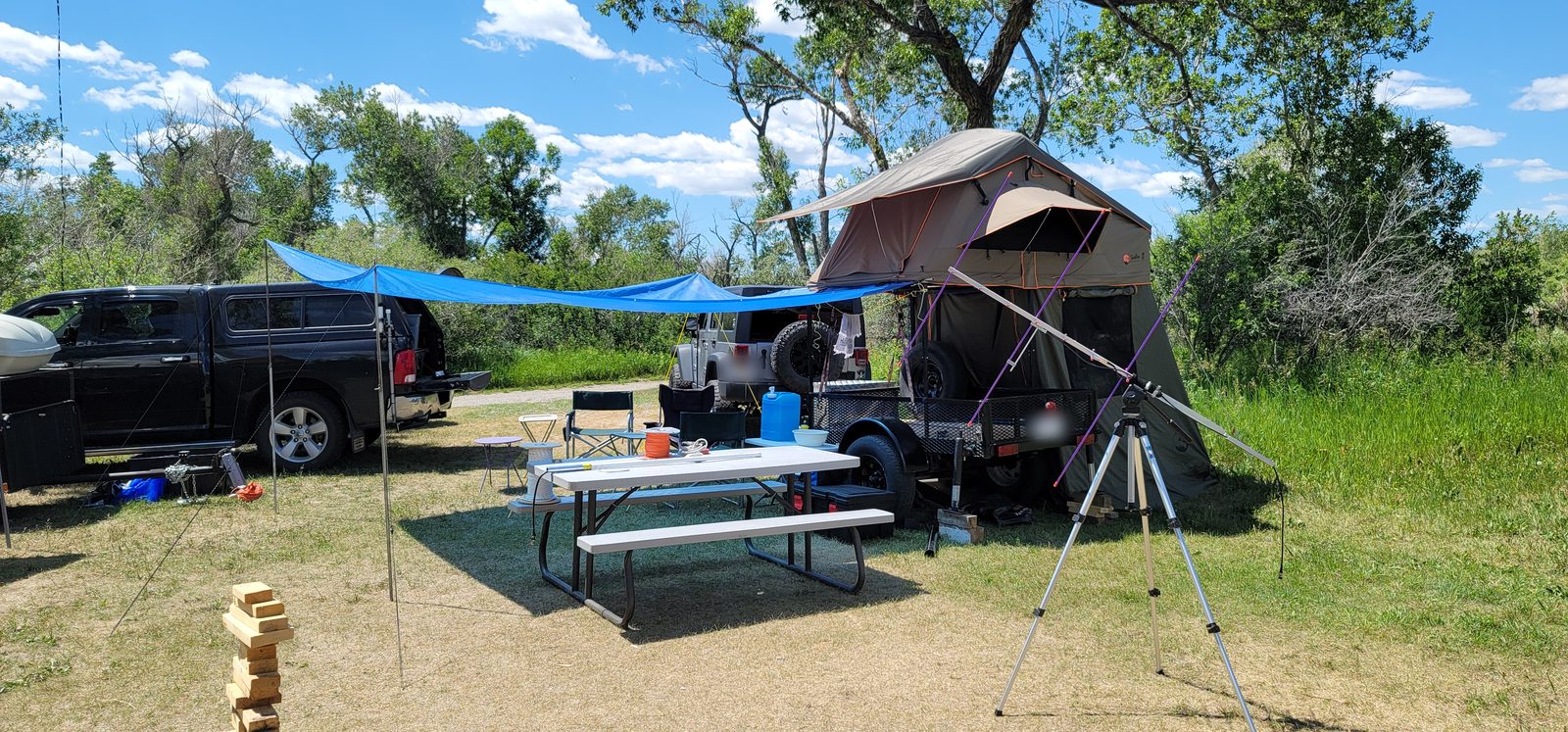
A tent trip can be as simple or as elaborate as you like. One good way to learn what you really need is to set a hard limit and stick to it. Gary did this for the first time this year with his friend Cory VE6COR for amateur radio Field Day, a yearly event when ham radio operators set up stations in the field, often in tents and campers, and practise communicating without the power grid. Cory is blind, and they plan to do it again next year.
“This year we did a minimal camp: if it didn’t fit in the truck, we couldn’t take it. We did that for Field Day, and we’re going to do it again this coming year. With his portable setup and my mobile setup it allows us to operate radios virtually anywhere.”
The tent-camping core list
Whatever your limit, these cover most trips. The Camp gear page explains each one.
Shelter
Tent with fly, poles, strong stakes and guy lines, a ground sheet cut smaller than the floor, a tarp and cord, a small mallet.
Sleep
Sleeping bag rated for the forecast low, insulated pad, pillow or stuff sack of clothes, warm hat.
Kitchen
Stove and fuel, lighter and backup, pot, utensils, cooler, water and a way to treat more, dish kit, garbage bags.
Clothing
Layers (no cotton), rain jacket, warm jacket, sturdy footwear, hat for sun and hat for cold.
Light and power
Headlamp for everyone, spare batteries, a charged battery pack and cable.
Safety
First aid kit, sun protection, insect repellent, multi-tool, whistle, map, and in the mountains, bear spray you know how to use.
A first-trip plan
- Pick a close, serviced campground for the first night out: a provincial park or town campground within an hour or so, with washrooms and water. Park Lake Provincial Park is close to Lethbridge. See Where to camp.
- Choose a settled forecast. Light winds, no thunderstorms, and an overnight low you’re equipped for. There’s no prize for toughing out a bad night on your first try.
- Practise at home. Pitch the tent, inflate the pads, light the stove outdoors, and pack the car the night before.
- Make a list, and tick it off as you load. Gary’s advice to new campers includes making a very good list.
- Arrive early with several hours of daylight. Pitch the tent first, then set up the kitchen.
- Tell someone where you’re going and when you’ll be back.
- Keep the first meal simple: something you can heat in one pot.
- Take notes after the trip: what you didn’t use, what you missed, what you’d change.
Packing up and tent care
- Dry it before you store it. A tent packed wet will mildew in a few days and can be ruined. If you have to pack up wet, set it up or hang it to dry as soon as you get home.
- Shake out the dirt and sweep the floor before you take it down.
- Count stakes and poles as you pack. Losing one stake a trip adds up.
- Fold poles from the middle so the shock cord isn’t overstretched.
- Store it loose and dry, out of sunlight. Long-term storage in a tight stuff sack is hard on the fabric and coatings.
- Repair small tears early with a tent repair patch, and re-seal seams when they start to leak.
- Sun wears tents out. Ultraviolet light weakens nylon and polyester over time. On a long stay, a tarp over the tent helps.
A Field Day tent camp
Tenting near Lethbridge: what to expect
Our wind, by the numbers
At the Lethbridge airport, Environment and Climate Change Canada’s climate normals (1981–2010) show west as the most common wind direction in every month of the year. The average speed is about 18 km/h, and December and January average over 20 km/h. The record gust is 171 km/h, from the west. Unless the forecast says otherwise, face the tent’s narrow end west.
Cold nights at the shoulders of the season
The average last spring frost at the airport is May 20, and the average first fall frost is September 17. A tent trip before or after those dates can easily bring a frosty night, so pack for below zero.
Waterton Townsite Campground
- Tent-only loops. Parks Canada lists two unserviced, tent-only sections: one with parking at the site, and one with walk-in sites. In 2026 the walk-in loop closed on September 7.
- Gravel pads. Every vehicle and tent must fit on the site’s gravel or paved pad. Bring sturdy stakes that will go into gravel, or a freestanding tent you can still stake and guy.
- Kitchen shelters. Wood fires are allowed only in the shared kitchen shelters, which have wood-burning stoves. They’re also a good place to cook out of the wind.
- Food stays out of the tent. Store all food and coolers in your vehicle or the food lockers, and don’t cook inside tents or tent trailers.
- Weather. Parks Canada says it can rain, snow or hail there at any time of year.
Writing-on-Stone / Áísínai’pi
The park’s Milk River valley campground has 14 unserviced and 45 powered sites, all suitable for tents, many in the shade of the trees. Shade is welcome on a hot day, but look up before you pitch: cottonwoods can drop big limbs in wind.
Before you camp by a river
Our rivers can rise fast after mountain rain. The Government of Alberta’s Alberta Rivers site and app show river flows, advisories, and flood watches and warnings. Check it before you pitch near the water, and again if heavy mountain rain is forecast.
Sources
- Environment and Climate Change Canada, Lightning safety when camping (tents not safe, safe shelters, campsite choice, the 30-minute rule): canada.ca
- Halifax Regional Municipality, Tent and trailer camping fire safety (no fuel-based appliances in or near tents, electric heater placement, unattended heaters): halifax.ca
- Government of Alberta, Camping on public land (camp at least 30 m from lakes and streams): alberta.ca
- Lethbridge Polytechnic, Wider Horizons, “Campus in season” (Lethbridge’s windy days): lethpolytech.ca
- ASTM International, Standardization News, “New standard will help keep sleeping campers warm” (sleeping pad R-value): sn.astm.org
- Your tent’s own instructions are the final word on pitching, guying and care.
- Environment and Climate Change Canada, Canadian Climate Normals 1981–2010, Lethbridge A (wind direction and speed; record gust; frost dates): climate.weather.gc.ca
- Parks Canada, Townsite Campground, Waterton Lakes National Park (tent-only loops, gravel pads, kitchen shelters, food storage): parks.canada.ca
- Parks Canada, Camping, Waterton Lakes National Park (rain, snow or hail any time of year): parks.canada.ca
- Alberta Parks, Writing-on-Stone Campground (14 unserviced and 45 powered sites): albertaparks.ca
- Government of Alberta, Alberta Rivers (flows, advisories, flood watches and warnings): rivers.alberta.ca